

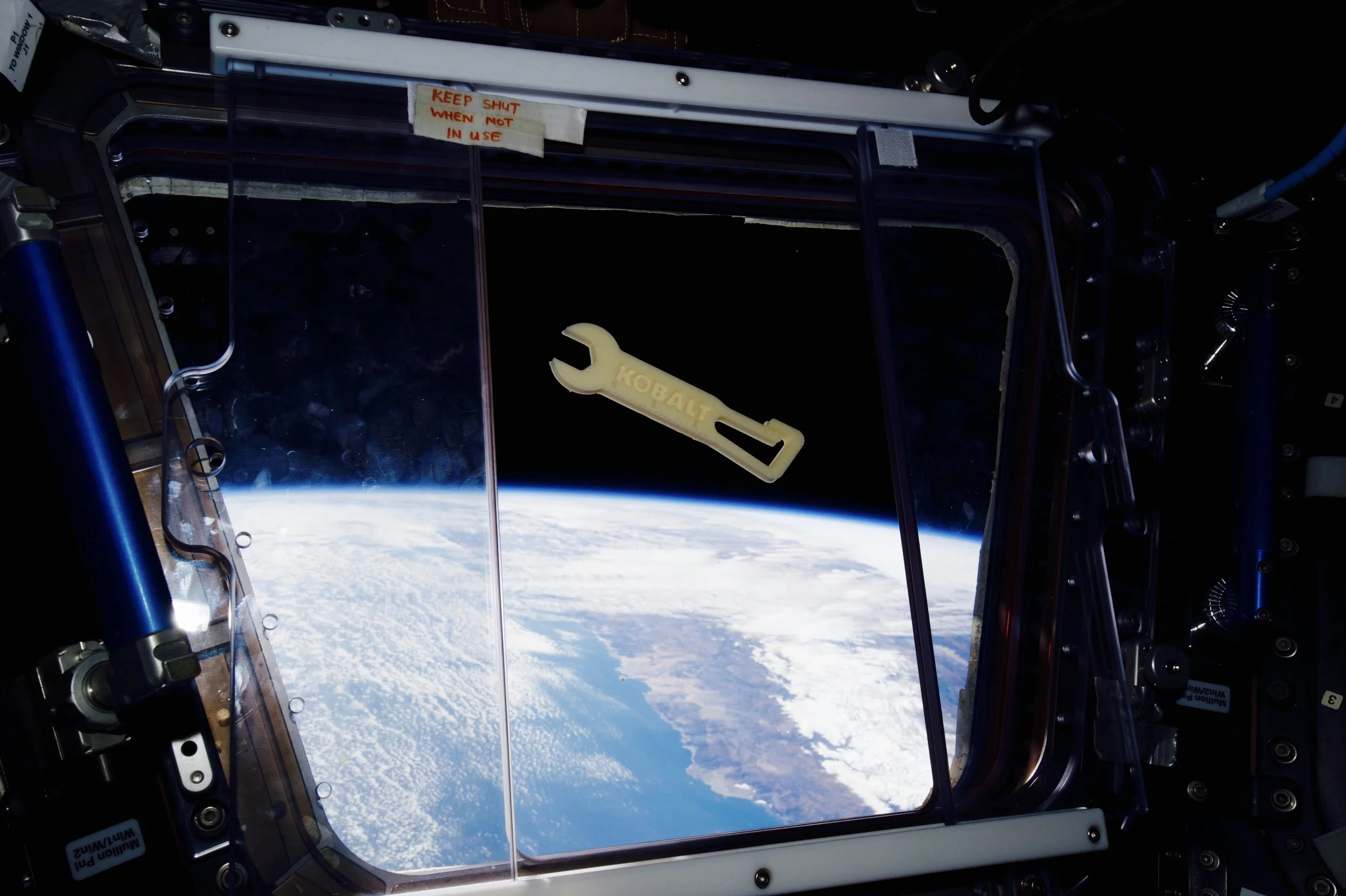
Most Engineers Learn Additive Manufacturing Years Too Late.
The companies winning contracts, cutting production costs, and building lighter, stronger components aren't waiting for the industry to catch up to them. They understood Design for Additive Manufacturing before it became a requirement.
This 8-week course, taught by a NASA Award-Winning Engineer with multiple AM and MedTech patents, gives you that foundation. Not theory. The actual methodology used to design and validate components for launch vehicles and aerospace systems.
The AM Skills Gap Is Costing Engineering Teams Real Money.
Additive manufacturing is no longer an emerging technology. It's a production requirement in aerospace, defense, and medical device sectors, and the engineers and firms who don't understand how to design for it are getting left behind.
Here's what that looks like in practice:
You're designing parts the way you were trained, for subtractive processes, and AM is fighting you at every step
Your organization invested in AM equipment, but the ROI hasn't materialized because your team doesn't know how to fully leverage it
You're watching competitors move faster, iterate cheaper, and produce geometries you can't match with conventional methods
You've tried to learn AM on your own, YouTube, forums, vendor datasheets, but there's no coherent methodology tying it together
You know AM is important for your career. You just haven't found the right structured path in.
The problem isn't that additive manufacturing is complicated. The problem is that most learning resources treat it like a tool, not a discipline. You don't need another overview. You need a methodology.

I Didn't Learn Additive Manufacturing in a Classroom.
I Learned It Where a Failed Component Means a Failed Mission.
My name is Travis Davis. Before I taught anyone about additive manufacturing, I spent years at NASA's Marshall Space Flight Center designing and testing liquid propulsion components, the systems that generate the thrust to get things into space.
At NASA, AM wasn't a trend we were exploring. It was a tool we were required to understand at a level where there was no room for imprecision. I worked with metal, polymer, and resin additive manufacturing daily. I developed methods that were novel enough that NASA patented them. I saw what happened when engineers without DfAM training tried to design parts for additive processes, and I saw what was possible when they understood the methodology.
After NASA, I earned a Master of Science in Biomedical Engineering as a George J. Mitchell Scholar at Trinity College Dublin, one of twelve Americans selected that year, with a focus on medical device design. AM follows you across industries when you understand it at a foundational level.
" The engineers who understand how to design for additive manufacturing, not just use it, are the ones defining what gets built next. "
I built this course because the methodology I developed and refined at NASA shouldn't take years and a government clearance to access. In 8 weeks, I'll give you the foundation that took me a career to build.
— Travis Davis
NASA Award-Winning Engineer · NASA Patent Holder · US-Ireland Alliance Scholar · MSc Biomedical Engineering · MedTech Patent Holder · Trinity College Dublin
This Isn't an Introduction to 3D Printing.
It's a Professional Engineering Methodology.
There's a significant difference between knowing that additive manufacturing exists and knowing how to engineer for it. This course is built for the second outcome.
Design for Additive Manufacturing (DfAM) is the discipline of understanding how AM processes, materials, and constraints should drive design decisions, from the first sketch to a validated, production-ready component. It's what separates engineers who use AM as a prototyping shortcut from engineers who use it as a competitive advantage.
In 8 structured weeks, you will move from AM literacy to AM fluency, with the ability to evaluate processes, select materials, design components, assess cost tradeoffs, and build the business case for AM adoption in your organization.
After 8 Weeks, You Will Be Able To:
✓ Speak the language of AM fluently, processes, materials, applications, and tradeoffs, in any engineering or business context
✓ Understand the fundamental principles governing polymers, resins, and metals in AM, and why each process has the performance envelope it does
✓ Identify where in a product lifecycle AM creates measurable value, and where it doesn't
✓ Design components specifically for additive processes, combining engineering judgment with computational design tools and process constraints
✓ Quantitatively evaluate the cost and performance of an AM part versus a conventionally manufactured equivalent
✓ Build a credible business case for AM adoption within your organization or for a client
✓ Position yourself and your team at the leading edge of digital manufacturing
These are not abstract learning objectives. They are the exact capabilities you will exercise, with real examples drawn from aerospace, medical, and industrial applications, across all 8 weeks.

8-Week Course Curriculum
Each week builds directly on the last. By Week 8, you're not just informed, you're equipped.
-
Vocabulary, terminology, and the current state of the AM industry
The AM workflow and digital thread, from file to finished part
First-hand accounts from industry leaders on how AM is being applied at scale
Why AM is not a replacement for conventional manufacturing, and when it's decisively superior
-
Comprehensive overview of all major AM process families
Polymer AM: FDM, SLA, SLS, MJF, principles, materials, and design implications
Resin AM: DLP, CLIP, and photopolymer systems
Metal AM: LPBF, DMLS, EBM, DED, process physics and performance envelopes
Side-by-side process comparison for application selection
-
Structured methodology for identifying where AM creates value at each lifecycle stage
Application examples across aerospace, automotive, medical device, and industrial sectors
How to classify and prioritize AM opportunities in your own product portfolio
Case studies drawn from Travis's NASA propulsion work and medical device research
-
Core DfAM principles, designing with the process, not around it
Support structures, build orientation, and their downstream effects
Wall thickness, feature resolution, and tolerance design for each process class
Common DfAM mistakes, and how to identify them before fabrication
-
Topology optimization, removing material intelligently for performance
Lattice structures, infill patterns, and when to use them
Part consolidation, combining multiple components into a single AM build
Design methods for novel geometries that are impossible in subtractive manufacturing
-
Build preparation software, slicing, nesting, support generation
Generative design tools, Fusion 360, nTopology, Altair Inspire
Process and part simulation, predicting distortion, residual stress, and failure
Digital thread integration, from CAD to build to inspection
-
How to quantify the cost of an AM part versus a conventional equivalent
Quality assurance for AM, inspection methods, post-processing, and certification
Performance vs. cost tradeoffs: when AM is economically justified
Supply chain implications of AM adoption, distributed manufacturing, on-demand production
-
Building a compelling internal business case for AM adoption
How to evaluate an AM investment for your organization
Critical technologies converging with AM: AI, robotics, advanced materials
Where the industry is heading, and how to position yourself ahead of it
Certificate of Completion, issued upon successful course completion
This Course Is Built For:
✓ Mechanical, aerospace, and manufacturing engineers who need a structured DfAM foundation
✓ Engineering managers and technical leads responsible for AM adoption at their organizations
✓ Product development teams in aerospace, defense, and medical device sectors
✓ University faculty and programs seeking an industry-grounded AM curriculum
✓ Technical professionals entering the AM field from adjacent disciplines
✓ Entrepreneurs and founders building AM-adjacent products or services
This Course Is Not For:
❌ Hobbyists or casual 3D printing enthusiasts looking for beginner tutorials
❌ Those seeking vendor-specific training on a single machine or software platform
❌ Anyone looking for a passive certification without doing the work
This is a professional development course with professional expectations. The engineers who get the most from it come in ready to engage, apply, and build.
Where Additive Manufacturing Is Being Used Right Now
The industries adopting AM at scale are the same ones that can least afford to wait for their engineering teams to catch up:

Aerospace + Defense
Liquid propulsion components, lightweight structural members, unmanned aerial vehicle airframes, satellite components, and mission-critical hardware where weight reduction and geometric complexity are requirements, not preferences.

Medical Device + Healthcare
Patient-specific orthopedic implants, surgical instruments, dental prosthetics, tissue engineering scaffolds, and biocompatible device housings are applications where customization is clinically necessary.

Industrial Manufacturing
Pre-production tooling, end-of-arm robotic tooling, jigs and fixtures, and low-volume production parts where conventional tooling investment isn't justified.
Automotive + Energy
Engine development components, high-performance parts, heat exchangers, and complex fluid management systems where internal geometry is otherwise unmanufacturable.

The global AM market is projected to reach $195 billion by 2035, growing at 22% annually. The engineers who understand DfAM today are the ones building that market.
Everything Included in Enrollment:
✓ 8 weeks of structured, professionally developed curriculum
✓ Video lessons with downloadable reference materials for each module
✓ Design exercises and application case studies drawn from real aerospace and medical projects
✓ Software tool walkthroughs for DfAM, generative design, and build preparation
✓ Cost and value analysis frameworks you can apply immediately in your work
✓ Business case development template for internal AM adoption proposals
✓ Access to course materials after completion for ongoing reference
✓ Digital Certificate of Completion, issued upon successful course completion
✓ Direct instruction from a NASA patent-holding engineer with 6+ years of applied AM experience
This 8-week course, taught by a NASA Award-Winning Engineer with multiple AM and MedTech patents, gives you that foundation. Not theory. The actual methodology used to design and validate components for launch vehicles and aerospace systems.
Frequently Asked Questions
-
No. The course is structured to build from the ground up. Week 1 establishes vocabulary and foundational concepts before introducing any technical depth. Engineers with prior AM exposure will still find significant value in the methodology and DfAM frameworks introduced in Weeks 4–6.
-
Plan for 4–6 hours per week. This includes video lessons, reading materials, and the application exercises. The course is designed to fit around a full-time engineering role, not to compete with it.
-
If you work in aerospace, defense, medical device, automotive, energy, or industrial manufacturing, yes. The curriculum covers AM applications across all of these sectors with specific examples from each. The DfAM methodology is process-agnostic and applies regardless of which AM technology your organization uses.
-
The course is delivered online, at your pace within each week's module structure. Video lessons are accompanied by downloadable reference materials, design exercises, and case studies.
-
Yes. Learners who successfully complete all modules receive a Digital Certificate of Completion in Design for Additive Manufacturing from The Additive Space.
-
Yes. If you're interested in enrolling multiple engineers or developing a custom cohort for your team, contact us directly to discuss organizational pricing and delivery options.
-
If you complete the course and don't feel it delivered on what was promised, contact us. We stand behind the quality of this curriculum and will work with you to make it right.
The Engineers Shaping the Next Decade of Manufacturing
Are Learning This Now.
Additive manufacturing is not a future technology. It's a competitive requirement across aerospace, defense, medical devices, and other industrial sectors. The question isn't whether your engineering career or organization will need DfAM fluency. It's whether you'll have it before or after your competitors.
This is the course that closes that gap. 8 weeks. NASA-caliber methodology. A credential that reflects real engineering rigor.
Next cohort enrollment is open. Seats are limited.